

July Theme: Fall Prevention & Mobility Care for Seniors
This month’s feature focuses on common elderly issues: dizziness, knee pain, and leg weakness. Through Traditional Chinese Medicine (TCM) theory, we analyze the underlying constitutional causes and provide daily exercise routines, summer cooling and warming techniques, and dietary advice to comprehensively safeguard seniors' walking safety and joint health.
Understanding "Geriatric Dizziness":
Basic classification of dizziness in Traditional Chinese Medicine
As you age, do you often feel lightheaded or experience sudden dizziness? Many people consider dizziness normal in old age, but Traditional Chinese Medicine (TCM) identifies three common types: Qi and Blood Deficiency, with symptoms including dizziness and fatigue; Liver and Kidney Yin Deficiency, accompanied by tinnitus and poor sleep; and Phlegm-Dampness Obstruction, characterized by a heavy head and poor appetite. It is recommended that older adults seek help from a registered TCM practitioner as early as possible to regulate their bodies and improve their symptoms.

How to deal with morning dizziness:
"Slow-motion" exercises for seniors when getting out of bed
Many elderly people experience dizziness upon waking in the morning. This is because blood and energy are insufficient in the early morning. Getting up too quickly can easily trigger orthostatic hypotension or vertigo, and even lead to falls. To prevent morning dizziness, the elderly should learn the following "slow-motion 3-step routine": First, lie flat for 30 seconds after waking up and move your body; next, sit up on your side and hold for 30 seconds; finally, stand for 30 seconds while holding onto a stable object, and only walk after there is no dizziness. In addition, it is recommended to regulate blood and energy through acupuncture and traditional Chinese medicine.

Dietary tips to prevent dizziness:
Recommended medicinal diets and ingredients for those prone to dizziness
If you frequently experience dizziness, in addition to rest, dietary adjustments are also important. Traditional Chinese medicine believes in the concept of "medicine and food sharing the same origin," and choosing appropriate ingredients can replenish qi and blood. Two recommended medicinal diets for preventing dizziness are: 1) Astragalus, Codonopsis, and Red Date Chicken Soup, suitable for those with blood deficiency; 2) Tangerine Peel, Poria, Hyacinth Bean, and Lean Pork Soup, suitable for those with phlegm and dampness obstructing the middle jiao. In daily life, you can choose more ingredients such as mulberries and black sesame seeds, and avoid raw, cold, and greasy foods. If you experience persistent discomfort, it is recommended to seek help from a traditional Chinese medicine practitioner.

Improve lower limb weakness:
Effortless techniques for protecting your knees in daily life
Do you often experience leg weakness and knee joint strain? Learn these 3 energy-saving techniques to immediately reduce knee joint load and make walking easier! 1. When standing up, use both hands and feet together. Bring both feet back under the chair first, lean forward, and use your hands for support as you stand up. 2. When going upstairs, put your stronger leg on first; when going downstairs, put your weaker leg on first to reduce impact. 3. When lifting heavy objects, bend your hips without bending your knees, and keep your body close to the object before lifting. Lower limb weakness may be related to kidney deficiency; acupuncture and traditional Chinese medicine are recommended for treatment.

Keep your knees warm:
Preventing joint stiffness and pain in air-conditioned environments during summer
Entering an air-conditioned room is very comfortable in the hot summer, but many elderly people experience knee pain and stiffness due to air conditioning. Traditional Chinese medicine believes that cold air invading the joints, especially entering an air-conditioned environment immediately after being outdoors in high temperatures, can lead to stagnation of qi and blood, exacerbating knee problems. It is recommended that the elderly carry knee pads or small blankets to avoid direct exposure to cold air on their knees, and apply a hot towel to their knees in the morning or before bed to promote blood circulation. If stiffness is frequent, acupuncture and traditional Chinese medicine are recommended to improve symptoms.

Traditional Chinese Medicine (TCM) Therapeutic Mindset:
How to improve chronic dizziness by adjusting one's physical condition?
Many people frequently experience dizziness, and although hospital tests come back normal, they still feel unwell. Traditional Chinese medicine believes that chronic dizziness is a warning sign of "imbalance in the body's constitution," and treatment requires identifying the root cause. Common types of dizziness include those with qi and blood deficiency, liver and kidney deficiency, and phlegm-dampness obstruction, each corresponding to different treatment methods. Ji Feng Tang TCM Clinic diagnoses each elderly person's constitution and uses acupuncture and herbal medicine to improve chronic dizziness and restore their vitality.

Early stages of knee joint degeneration:
Self-testing and daily protection tips
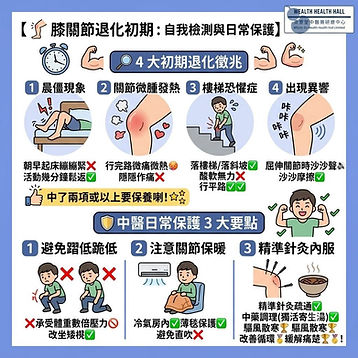
Do you feel weakness in your knees when climbing stairs? Do your joints feel tight and make clicking sounds when you wake up in the morning? Bone degeneration isn't just a problem for the elderly; wear and tear can begin as early as your 30s and 40s. Check if you have these four early signs of bone degeneration: morning stiffness, slight swelling and warmth in your joints, stair phobia, and unusual noises. If you have two or more of these, you should start taking care of your joints. Traditional Chinese medicine suggests avoiding squatting and kneeling, keeping your joints warm, and improving blood circulation through acupuncture and herbal medicine.
Traditional Chinese Medicine Perspective:
Why is the saying "the kidneys govern the bones and the liver governs the tendons" related to weakness in the lower limbs?
Feeling weakness in the legs while walking, or knee weakness when going up and down stairs, is often attributed to joint degeneration. However, Traditional Chinese Medicine (TCM) believes it is closely related to the liver and kidneys. The kidneys govern the bones, providing nourishment to the bone marrow, while the liver governs the tendons, ensuring flexibility of the muscles and bones. As we age, kidney qi decreases, potentially leading to osteoporosis and muscle stiffness. Treatment methods include acupuncture and herbal remedies to strengthen liver and kidney function and restore leg strength.

Strengthen the knee joint:
Simple stretching and exercise routines suitable for seniors at home
Many elderly people think that "joint degeneration" means they should move less, but that's actually the opposite! Lack of activity leads to muscle atrophy around the knee, increasing the burden on the joint and accelerating degeneration. Strong muscles help reduce stress on the knee joint. Here are three simple stretches you can do at home to help strengthen your knee joints.

Health preservation during the Great Heat:
Cooling you down while preventing dizziness and fatigue caused by "dampness and heat affecting the spleen".
The Great Heat (Dàshǔ) is the hottest and most humid time of the year. Many people experience fatigue, dizziness, and loss of appetite, which may be signs of "damp-heat trapping the spleen." Traditional Chinese medicine believes that the spleen prefers dryness. Summer's high temperatures and frequent rain, coupled with the effects of air conditioning and cold drinks, easily lead to the accumulation of damp-heat, hindering spleen and stomach function. Here are three ways to maintain health: eat a light diet and avoid excessive cold drinks; avoid drastic changes in air conditioning; drink small amounts of water frequently, preferably warm water or cooling teas. If symptoms persist, it is recommended to seek treatment through acupuncture and traditional Chinese medicine as soon as possible.

Dizziness and environment:
The effects of changes in indoor temperature and air pressure on dizziness
People prone to dizziness are susceptible to it caused by changes in weather or large temperature differences between indoors and outdoors. This is because blood vessels have poor elasticity, and rapid temperature changes can cause fluctuations in blood pressure, affecting blood supply to the brain. Changes in air pressure can also obstruct the flow of qi and blood, making the elderly feel heavy. Coping methods include allowing time to adjust before entering or leaving air-conditioned rooms, and applying pressure to the Taiyang (GV23) and Fengchi (GB20) acupoints for relief. If dizziness is frequent, it is recommended to seek acupuncture and traditional Chinese medicine treatment.

Summary:
Preventing knee pain and falls in the elderly starts with daily health care.
For us seniors, "good leg strength" is key to a high quality of life! Knee pain not only affects daily life but also increases the risk of falls. Here are four rules to prevent knee pain and falls: 1. Move slowly to avoid losing your balance. 2. Keep your joints warm and avoid direct exposure to cold air. 3. Move sparingly, paying attention to how you stand up and go up and down stairs. 4. Move your muscles, performing simple stretches and leg raises daily. If you still experience pain or weakness, it is recommended to seek medical attention as soon as possible.
